
From 1999 to 2009, the company’s factories assembled the 2.3-liter Saab B235R turbo engine, which was fitted to the first generation of the well-liked 9-3 and 9-5 models in the charged Aero version. This device was essentially a lightweight version of the popular B234R turbocharged engine.
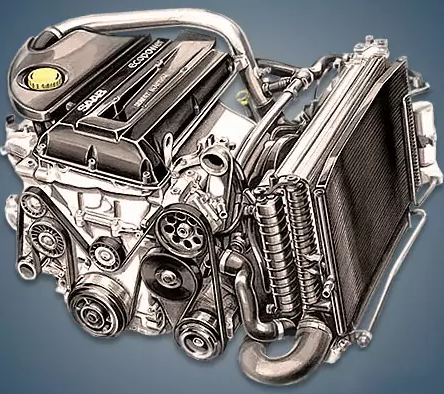
B234E, B234i, B234R, B235E, and B235R are 2.3-liter H-series engines.
Specifications
| Production years | 1999-2009 |
| Displacement, cc | 2290 |
| Fuel system | distributed injection |
| Power output, hp | 230 – 260 |
| Torque output, Nm | 350 – 370 |
| Cylinder block | cast iron R4 |
| Block head | aluminum 16v |
| Cylinder bore, mm | 90 |
| Piston stroke, mm | 90 |
| Compression ratio | 9.3 |
| Features | intercooler |
| Hydraulic lifters | yes |
| Timing drive | chain |
| Phase regulator | no |
| Turbocharging | MHI TD04HL-15T |
| Recommended engine oil | 0W-30 |
| Engine oil capacity, liter | 4.0 |
| Fuel type | petrol |
| Euro standards | EURO 3/4 |
| Fuel consumption, L/100 km (for Saab 9-5 Aero 2007) — city — highway — combined |
12.8 6.4 8.8 |
| Engine lifespan, km | ~200 000 |
The engine was installed on:
- Saab 9-3 I (YS3D) in 1999 – 2002;
- Saab 9-5 I (YS3E) in 1999 – 2009.
Disadvantages of the Saab B235R engine
First of all, frequent oil leaks, particularly at the joints, are a concern for this motor;
Hydraulic lifters have a limited capacity and frequently reach 150,000 kilometers;
The oil pump frequently wears out by the same run, endangering the liners; oil scraper rings and lubricant consumption appear closer to 200,000 km;
This unit’s lightweight pistons can easily burn out, so tuning is not tolerated;
Large resources are not different in the block of balancers; typically, they are eliminated;
The engine’s turbine, electric throttle, and ignition cassette are also weak points.