
From 1997 to 2010, a number of well-known concern models built on the Polo 3 and Golf 4 platforms were equipped with the 1.9-liter Volkswagen ALH 1.9 TDI diesel engine. Such a power unit has a simplified version that has its own AGR index.
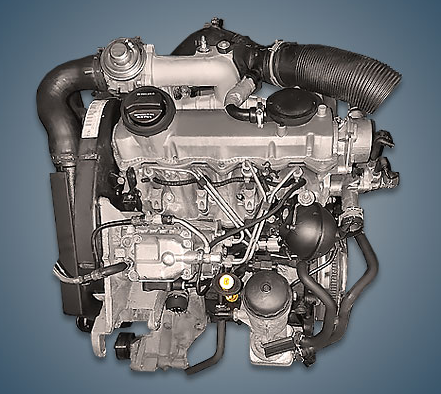
1Z, AFN, AHF, AHU, ALH, AVG, AKU, and AEY are further models in the EA180 series.
Specifications
| Production years | 1997-2010 |
| Displacement, cc | 1896 |
| Fuel system | direct injection |
| Power output, hp | 90 |
| Torque output, Nm | 210 |
| Cylinder block | cast iron R4 |
| Block head | aluminum 8v |
| Cylinder bore, mm | 79.5 |
| Piston stroke, mm | 95.5 |
| Compression ratio | 19.5 |
| Features | SOHC |
| Hydraulic lifters | yes |
| Timing drive | belt |
| Phase regulator | no |
| Turbocharging | yes |
| Recommended engine oil | 5W-40 |
| Engine oil capacity, liter | 4.3 |
| Fuel type | diesel |
| Euro standards | EURO 2/3 |
| Fuel consumption, L/100 km (for VW Golf 2000) — city — highway — combined |
6.5 4.1 4.9 |
| Engine lifespan, km | ~440 000 |
The engine was installed on:
- Audi A3 1 (8L) in 1997 – 2001;
- Skoda Octavia 1 (1U) in 2000 – 2010;
- Seat Cordoba 1 (6K) in 1999 – 2002;
- Seat Ibiza 2 (6K) in 1999 – 2002;
- Seat Leon 1 (1M) in 2000 – 2005;
- Seat Toledo 2 (1M) in 1999 – 2004;
- Volkswagen Bora 1 (1J) in 1998 – 2002;
- Volkswagen Caddy 2 (9K) in 2000 – 2003;
- Volkswagen Golf 4 (1J) in 1997 – 2002;
- Volkswagen Polo 3 (6N) in 1999 – 2001.
Disadvantages of the VW ALH engine
Turbine valve or EGR contamination is the primary cause of thrust failures;
Here, antifreeze leaks are frequently caused by a cracked cooling tee;
Additionally, the engine pan is greasy and the lower flange of the crankcase ventilation tube frequently bursts;
A broken ribbed belt poses a serious risk because it can affect timing.
Valve seats frequently burn out and compression decreases after 200,000 kilometers.