
The fifth generation Golf and Jetta models, the Passat B6, and the second Octavia all had the 2.0-liter Volkswagen BVZ 2.0 FSI gasoline engine, which was manufactured between 2005 and 2010. This unit’s lower compression ratio and EURO 2 environmental class set it apart from BVY.
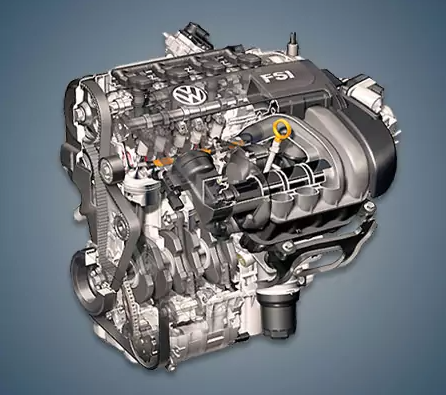
BVY and BVZ are part of the EA113-FSI series.
Specifications
| Production years | 2005-2010 |
| Displacement, cc | 1984 |
| Fuel system | direct injection |
| Power output, hp | 150 |
| Torque output, Nm | 200 |
| Cylinder block | aluminum R4 |
| Block head | aluminum 16v |
| Cylinder bore, mm | 82.5 |
| Piston stroke, mm | 92.8 |
| Compression ratio | 10.5 |
| Features | DOHC |
| Hydraulic lifters | yes |
| Timing drive | chain & belt |
| Phase regulator | on the intake shaft |
| Turbocharging | no |
| Recommended engine oil | 5W-30 |
| Engine oil capacity, liter | 4.6 |
| Fuel type | petrol |
| Euro standards | EURO 2 |
| Fuel consumption, L/100 km (for VW Golf 2007) — city — highway — combined |
10.6 5.9 7.6 |
| Engine lifespan, km | ~260 000 |
The engine was installed on:
- Audi A3 2 (8P) in 2005 – 2006;
- Skoda Octavia 2 (1Z) in 2005 – 2008;
- Volkswagen Golf 5 (1K) in 2005 – 2008;
- Volkswagen Jetta 5 (1K) in 2005 – 2008;
- Volkswagen Passat B6 (3C) in 2005 – 2008.
Disadvantages of the VW BVZ engine
This power unit may not start at all in the winter because it cannot withstand frost.
Soot on the intake valves is typically the cause of the motor’s erratic operation.
Here, there are few resources for the ignition coils, thermostat, and phase regulator.
The oil burn often starts when oil scraper rings are located 100,000 kilometers away.