
From 2011 to 2015, the company manufactured the 2.0-liter VW CCZD 2.0 TSI turbo engine, which was mounted on a redesigned Volkswagen Tiguan crossover. Such a power unit didn’t show up in some automotive markets right away following the model’s update; it wasn’t until 2015.
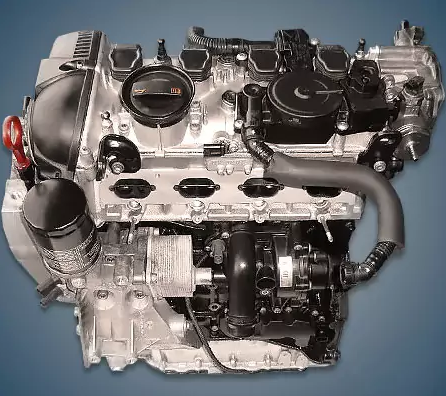
CDAA, CDAB, CDHA, CDHB, CCZA, CCZB, CCZC, CCZD, CDNB, CDNC, CAEA, and CAEB are all part of the EA888 gen2 series.
Specifications
| Production years | 2011-2015 |
| Displacement, cc | 1984 |
| Fuel system | direct injection |
| Power output, hp | 180 |
| Torque output, Nm | 280 |
| Cylinder block | cast iron R4 |
| Block head | aluminum 16v |
| Cylinder bore, mm | 82.5 |
| Piston stroke, mm | 92.8 |
| Compression ratio | 9.6 |
| Features | DOHC |
| Hydraulic lifters | yes |
| Timing drive | chain |
| Phase regulator | on the intake shaft |
| Turbocharging | KKK K03 |
| Recommended engine oil | 5W-30 |
| Engine oil capacity, liter | 4.6 |
| Fuel type | petrol |
| Euro standards | EURO 5 |
| Fuel consumption, L/100 km (for VW Tiguan 2012) — city — highway — combined |
11.6 7.0 8.7 |
| Engine lifespan, km | ~250 000 |
| Weight, kg | 142 |
The engine was installed on:
- Volkswagen Tiguan 1 (5N) in 2011 – 2015.
Disadvantages of the VW CCZD engine
First of all, this line’s power units are well-known for using a lot of oil; they either use decoking or replace the piston to eliminate the oil burner.
The unit quickly cokes and operates unstably due to the continuous lubricant waste; the timing chain is characterized by a low resource, typically serving less than 100,000 km;
The owners also lament the unreliable injection and plastic water pumps.