
The most straightforward and affordable engine for developing nations was the 1.6-liter Volkswagen CWVA 1.6 MPI gasoline engine, which debuted in 2014. This power unit differs greatly from its predecessor CFNA, which was part of the previous EA111 series, because it was built using a 1.4-liter turbo engine from the EA211 family.
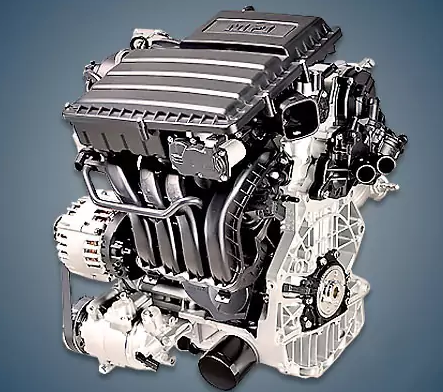
Here, a timing belt is used in place of a chain, the cylinder head is integrated with an exhaust manifold, and the intake shaft has a phase regulator. The power went from 105 to 110 horsepower.
The block has a 16-valve cylinder head with hydraulic compensators and is made of aluminum with cast iron sleeves. There are no knock issues because the connecting rod and piston group have undergone significant modernization. The engine’s environmental class was upgraded to EURO 5 because of the new exhaust design.
CWVA, CWVB, CJZA, CJZB, CHPA, CMBA, CXSA, CZCA, CZDA, CZEA, DJKA, DACA, and DADA are all part of the EA211 series.
Specifications
| Production years | since 2014 |
| Displacement, cc | 1598 |
| Fuel system | injector |
| Power output, hp | 110 |
| Torque output, Nm | 155 |
| Cylinder block | aluminum R4 |
| Block head | aluminum 16v |
| Cylinder bore, mm | 76.5 |
| Piston stroke, mm | 86.9 |
| Compression ratio | 10.5 |
| Features | DOHC |
| Hydraulic lifters | yes |
| Timing drive | belt |
| Phase regulator | on the intake shaft |
| Turbocharging | no |
| Recommended engine oil | 5W-30, 5W-40 |
| Engine oil capacity, liter | 3.6 |
| Fuel type | petrol |
| Euro standards | EURO 5 |
| Fuel consumption, L/100 km (for VW Polo Sedan 2016) — city — highway — combined |
7.8 4.6 5.8 |
| Engine lifespan, km | ~220 000 |
The engine was installed on:
- Skoda Karoq 1 (NU) since 2019;
- Skoda Octavia 3 (5E) in 2014 – 2020; Octavia 4 (NX) since 2020;
- Skoda Rapid 1 (NH) in 2015 – 2020; Rapid 2 (NK) since 2019;
- Skoda Yeti 1 (5L) in 2014 – 2018;
- Volkswagen Caddy 4 (SA) in 2015 – 2020; Caddy 5 (SB) since 2020;
- Volkswagen Golf 7 (5G) in 2014 – 2017;
- Volkswagen Jetta 6 (1B) in 2016 – 2019; Jetta 7 (BU) since 2020;
- Volkswagen Polo Sedan 1 (6C) in 2015 – 2020; Polo Liftback 1 (CK) since 2020;
- Volkswagen Taos 1 (CP) since 2021.
Disadvantages of the VW CWVA engine
The most well-known issue is excessive oil consumption, which rises as a result of rings. The owners are struggling with the oil burner by selecting the optimal lubricant and not without success. It’s important to keep in mind that there isn’t an oil level sensor and that you need to get the dipstick on a regular basis.
Thermal imbalance results from exhaust gases continuously breaking back into the cylinders due to the engine’s exhaust system design. This causes the motor to operate unevenly, vibrate, and use fewer resources. It is not feasible to swap out the exhaust for a different one because it is constructed in tandem with the cylinder head.
The camshaft seals are probably leaking if you discover new grease residue in the timing belt housing. On the other hand, replacing them is a relatively cheap procedure.
At 100,000 kilometers, a plastic water pump with two integrated thermostats frequently begins to leak. The remarkable cost of the part is the issue, not the leak itself.
Hydraulic lifters start to knock under the hood as soon as the oil gets close to the minimum level. When the unit has not yet warmed up, they are particularly audible in the cold.