
The Audi 4.0-liter 8-cylinder bi-turbo engineThe company has been producing CXYA since 2020, and it is installed in the 60 TFSI version of the A8 D5 executive sedan, which is popular in several countries. For the Audi S8, a more potent version of this power unit has a separate CWWB index.
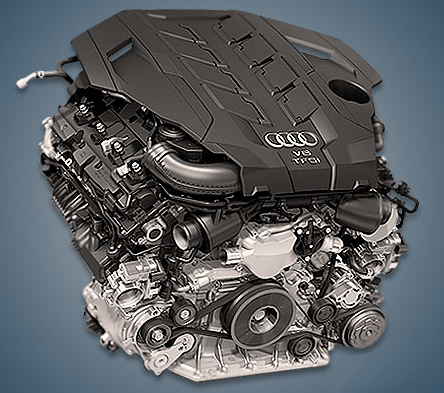
The EA825 series includes: CXYA, DCUE.
Specifications
| Production years | since 2020 |
| Displacement, cc | 3996 |
| Fuel system | direct injection |
| Power output, hp | 460 |
| Torque output, Nm | 660 |
| Cylinder block | aluminum V8 |
| Block head | aluminum 32v |
| Cylinder bore, mm | 86 |
| Piston stroke, mm | 86 |
| Compression ratio | 11.0 |
| Features | AVS, mild hybrid |
| Hydraulic lifters | yes |
| Timing drive | chain |
| Phase regulator | on all shafts |
| Turbocharging | two BorgWarner B03G |
| Recommended engine oil | 0W-20 |
| Engine oil capacity, liter | 9.5 |
| Fuel type | petrol |
| Euro standards | EURO 6d-TEMP |
| Fuel consumption, L/100 km (for Audi A8 2020) — city — highway — combined |
13.1 7.7 9.9 |
| Engine lifespan, km | ~300 000 |
| Weight, kg | 231 |
The engine was installed on:
- Audi A8 D5 (4N) since 2020.
Disadvantages of the Audi CXYA engine
This motor is very dependable for such a complicated design, and there aren’t many complaints about it;
The most important thing is to avoid purchasing the engine after extensive tuning—there are plenty of these available;
Low-quality fuel is not tolerated by plasma spraying on cylinder walls;
Turbine service life is significantly shortened by low-quality oil and lengthy oil change intervals;
A very costly cooling module failure has also been the subject of sporadic complaints.