
Only the Audi A4 B5 and the VW Passat B5 co-platform were equipped with the 1.6-liter 8-valve Audi ANA engine, which was manufactured by the company between 1999 and 2000. This Euro 4 unit has an electric throttle, two lambda probes, an EPC, and an EGR valve.
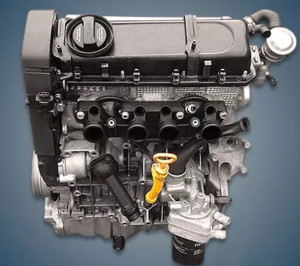
The EA113-1.6 series includes: AEH, AHL, AKL, ALZ, ANA, APF, ARM, AVU, BFQ, BGU, BSE, BSF.
Specifications
| Production years | 1999-2000 |
| Displacement, cc | 1595 |
| Fuel system | injector |
| Power output, hp | 101 |
| Torque output, Nm | 140 |
| Cylinder block | aluminum R4 |
| Block head | aluminum 8v |
| Cylinder bore, mm | 81 |
| Piston stroke, mm | 77.4 |
| Compression ratio | 10.3 |
| Features | EGR, EPC |
| Hydraulic lifters | yes |
| Timing drive | belt |
| Phase regulator | no |
| Turbocharging | no |
| Recommended engine oil | 5W-40 (approval: VW 502 00 or VW 505 00) |
| Engine oil capacity, liter | 4.5 |
| Fuel type | petrol |
| Euro standards | EURO 4 |
| Fuel consumption, L/100 km (for Audi A4 2000) — city — highway — combined |
11.3 6.0 7.5 |
| Engine lifespan, km | ~330 000 |
The engine was installed on:
- Audi A4 B5 (8D) in 1999 – 2000;
- Volkswagen Passat B5 (3B) in 1999 – 2000.
Disadvantages of the Audi ANA engine
Since this is a resource motor, major issues only arise at high mileage.
It is worthwhile to check the fuel pump and fuel pressure regulator when the power goes out.
Additionally, air leaks or a mass air flow sensor may be the source of unstable operation.
The mechanism for altering the intake geometry is not the most reliable.
Oil consumption typically manifests after 200,000 kilometers as a result of ring and cap wear.