
From 2005 to 2009, popular models like the Golf 5, Jetta 5, Passat B6, and Audi A3 had the 2.0-liter Volkswagen BPY 2.0 TFSI gasoline engine installed in the rear of the 8P. Cars intended for the American market typically have such a power unit.
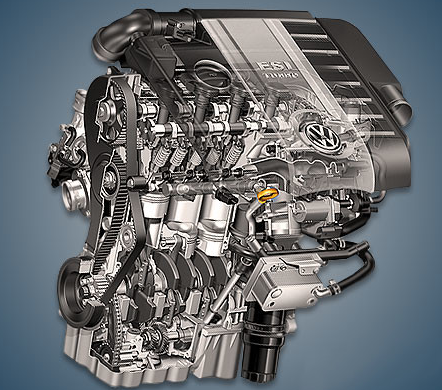
AXX, BPY, and BWA are part of the EA113-TFSI series.
Specifications
| Production years | 2005-2009 |
| Displacement, cc | 1984 |
| Fuel system | direct injection |
| Power output, hp | 200 |
| Torque output, Nm | 280 |
| Cylinder block | cast iron R4 |
| Block head | aluminum 16v |
| Cylinder bore, mm | 82.5 |
| Piston stroke, mm | 92.8 |
| Compression ratio | 10.5 |
| Features | DOHC |
| Hydraulic lifters | yes |
| Timing drive | chain & belt |
| Phase regulator | on the intake shaft |
| Turbocharging | KKK K03 |
| Recommended engine oil | 5W-30 |
| Engine oil capacity, liter | 4.6 |
| Fuel type | petrol |
| Euro standards | EURO 4 |
| Fuel consumption, L/100 km (for VW Golf 2006) — city — highway — combined |
11.3 6.5 8.1 |
| Engine lifespan, km | ~250 000 |
| Weight, kg | 155 |
The engine was installed on:
- Audi A3 2 (8P) in 2005 – 2008;
- Volkswagen Golf 5 (1K) in 2005 – 2009;
- Volkswagen Eos 1 (1F) in 2007 – 2008;
- Volkswagen Jetta 5 (1K) in 2005 – 2008;
- Volkswagen Passat B6 (3C) in 2005 – 2008.
Disadvantages of the VW BPY engine
The unit’s most well-known issues are the oil burner and increased soot formation; soot causes the intake manifold flaps to jam and their motor to fail;
The most common way to eliminate the oil burner is to replace the native pistons with forged ones;
The phase regulator and injection pump drive pusher have relatively limited resources;
The camshaft chain may stretch after 100,000 kilometers, causing knocks. The engine’s weak points are the bypass valve N249 and ignition coils.