
From 2004 to 2008, top versions of popular models like the 300C, Charger, and Grand Cherokee were equipped with the Chrysler EZB or HEMI 5.7 5.7-liter V8 engine, which was manufactured in Mexico. An MDS half-cylinder off-load system was installed in this power unit.
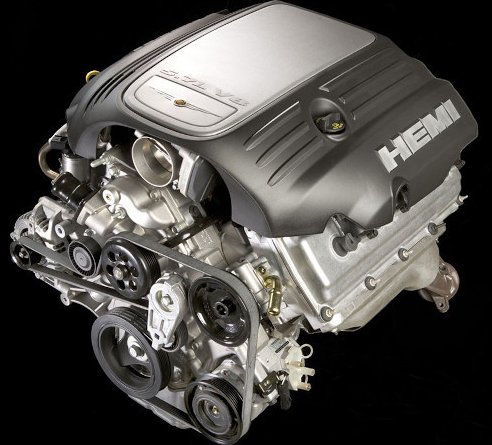
The internal combustion engines EZA, EZH, ESF, and ESG are also part of the HEMI series.
The Chrysler HEMI 5.7 EZB engine has a single camshaft (OHV), two aluminum heads with hemispherical combustion chambers, a cast-iron block, and two valves per cylinder for a total of sixteen valves. The Chrysler HEMI 5.7 engine had a distributorless coil over plug ignition system with two spark plugs per cylinder, an electronically controlled Sequential Multi-Port Electronic Fuel Injection system, and a Multi-Displacement System (MDS) that allowed the engine to transition from eight to four cylinders.
The engine was installed on:
- Chrysler 300C 1 (LX) in 2004 – 2008;
- Dodge Charger 1 (LX) in 2005 – 2008;
- Dodge Magnum 1 (LE) in 2004 – 2008;
- Jeep Commander 1 (XK) in 2005 – 2008;
- Jeep Grand Cherokee 3 (WK) in 2004 – 2008.
Specifications
| Production years | 2004-2008 |
| Cylinder block alloy | cast iron |
| Fuel system | injector |
| Configuration | V8 |
| Number of cylinders | 8 |
| Valves per cylinder | 2 |
| Block head | aluminum, 16v |
| Hydraulic lifters | yes |
| Timing drive | chain |
| Phase regulator | no |
| Turbocharging | no |
| Piston stroke, mm | 90.9 |
| Cylinder bore, mm | 99.5 |
| Compression ratio | 9.6 |
| Displacement, cc | 5654 |
| Power output, hp | 325 – 345 |
| Torque output, Nm | 500 – 530 |
| Fuel type | petrol |
| Euro standards | EURO 3 |
| Weight, kg | — |
| Fuel consumption, L/100 km (for Chrysler 300C 2005) — city — highway — combined |
18.1 8.7 12.1 |
| Recommended engine oil | 5W-20 |
| Engine oil capacity, liter | 6.7 |
| Engine lifespan, km | ~375 000 |
Disadvantages of the EZB engine
The only issue raised by the owners is the high consumption of these motors, which are incredibly dependable;
5W-20 oil is needed for the MDS system and hydraulic lifters to function normally; prolonged use of low-quality fuel causes the EGR valve to stick here; occasionally the exhaust manifold leads to the point where the fastening studs burst; and there are frequently odd noises under the hood that are referred to on the forums as “Hemi ticking.”