
Since 2013, the company’s factory has been producing the 1.5-liter turbo engine Great Wall GW4G15B, which is installed on popular Chinese models like the Hover H6 and Hawal H6. In essence, this motor is an upgraded version of the well-known Japanese Toyota 1NZ-FE engine.
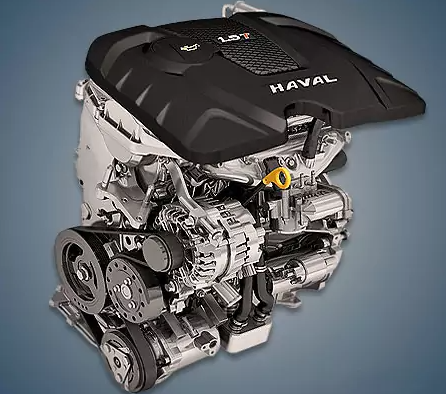
Toyota engine clones: GW4G15, GW4G15B, GW4G15K, and GW491QE.
Specifications
| Production years | since 2013 |
| Displacement, cc | 1497 |
| Fuel system | distributed injection |
| Power output, hp | 143 – 150 |
| Torque output, Nm | 203 – 210 |
| Cylinder block | aluminum R4 |
| Block head | aluminum 16v |
| Cylinder bore, mm | 75 |
| Piston stroke, mm | 84.7 |
| Compression ratio | 9.3 |
| Features | DOHC |
| Hydraulic lifters | no |
| Timing drive | chain |
| Phase regulator | VVTi at the intake |
| Turbocharging | MHI TF035HM |
| Recommended engine oil | 5W-30 |
| Engine oil capacity, liter | 4.3 |
| Fuel type | petrol |
| Euro standards | EURO 5 |
| Fuel consumption, L/100 km (for Haval H6 2018) — city — highway — combined |
11.3 7.1 9.2 |
| Engine lifespan, km | ~200 000 |
| Weight, kg | 115 |
The engine was installed on:
- Great Wall Hover H6 since 2013;
- Haval H2 I in 2014 – 2021;
- Haval H6 I since 2013.
Disadvantages of the Great Wall GW4G15B engine
Oil consumption is the primary issue with this turbo engine and all of the family’s engines;
Rings and inadequate crankcase ventilation are the causes of the oil burner;
The timing chain frequently needs to be changed after 100,000 kilometers, usually in conjunction with a phase shifter;
The ignition system, turbine valve, and unit supports are additional weak points; pushers must be chosen to modify the valve clearance every 90,000 kilometers.