
From 1989 to 2002, the company produced the 2.0-liter Honda F20A gasoline engine, which was fitted to several of the Japanese company’s well-known models, most notably the Accord and Prelude. The F20A power unit underwent five injection and three carburetor modifications.
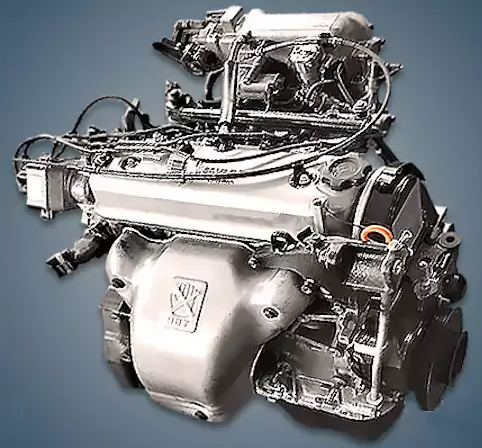
Internal combustion engines F18B, F20B, F20C, F22B, and F23A are also part of the F-series.
The engine was mounted on:
- Honda Accord 4 (CB) in 1989 – 1994;
- Honda Accord 6 (CG) in 1997 – 2002;
- Honda Ascot 1 (CB) in 1989 – 1993;
- Honda Ascot Innova 1 (CB) in 1992 – 1996;
- Honda Prelude 4 (BA8) in 1991 – 1996;
- Honda Prelude 5 (BB) in 1996 – 2001;
- Rover 620i in 1993-1999 (under the indices F20Z1 and F20Z2).
Specifications
| Production years | 1989-2002 |
| Displacement, cc | 1997 |
| Fuel system | carburetor (F20A2, F20A3, F20A6) injector (F20A4, F20A5, F20A7, F20A8) injector (DOHC F20A) |
| Power output, hp | 90 – 110 (F20A2, F20A3, F20A6) 130 – 140 (F20A4, F20A5, F20A7, F20A8) 152 (DOHC F20A) |
| Torque output, Nm | 150 (F20A2, F20A3, F20A6) 175 – 185 (F20A4, F20A5, F20A7, F20A8) 185 (DOHC F20A) |
| Cylinder block | aluminum R4 |
| Block head | aluminum 16v |
| Cylinder bore, mm | 85 |
| Piston stroke, mm | 88 |
| Compression ratio | 8.9 (F20A2, F20A3, F20A6) 9.5 (F20A4, F20A5, F20A7, F20A8) 9.5 (DOHC F20A) |
| Features | SOHC (F20A2, F20A3, F20A6) SOHC (F20A4, F20A5, F20A7, F20A8) DOHC (DOHC F20A) |
| Hydraulic lifters | no |
| Timing drive | belt |
| Phase regulator | no |
| Turbocharging | no |
| Recommended engine oil | 5W-30 |
| Engine oil capacity, liter | 3.8 |
| Fuel type | petrol |
| Euro standards | EURO 2/3 |
| Fuel consumption, L/100 km (for Honda Accord 1997) — city — highway — combined |
11.2 6.7 8.4 |
| Engine lifespan, km | ~300 000 |
| Weight, kg | 145 |
Disadvantages of the Honda F20A engine
Oil burn after 100,000 kilometers is the most well-known issue with these units;
Frequent coolant and oil leaks rank second in popularity;
The valve typically bends when the timing belt breaks, which lasts for about 90,000 kilometers;
When the distributor or one of the sensors fails, the motor can frequently begin to blunt;
Every 40,000 kilometers, valve clearances must be changed because there are no hydraulic lifters.