
From 1988 to 2002, the 1.3-liter Honda D13B gasoline engine was manufactured in Japan and fitted to the company’s well-known models, including the City, Logo, and three Civic generations. A version of the D13B motor with an injector and carburetor and a cylinder head for eight or sixteen valves was manufactured.
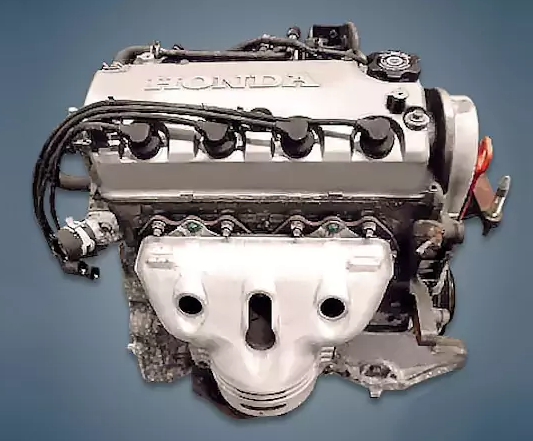
Internal combustion engines D14A, D15B, D16A, and D17A are also part of the D-series.
The engine was mounted on:
- Honda City 3 (SX) in 1996 – 2002;
- Honda Civic 4 (EF) in 1988 – 1991;
- Honda Civic 5 (EG) in 1991 – 1996;
- Honda Civic 6 (EJ) in 1995 – 2000;
- Honda Logo 1 (GA) in 1996 – 2001.
Specifications
| Production years | 1988-2002 |
| Displacement, cc | 1343 |
| Fuel system | carburetor (PGM-CARB 16v: D13B1 and D13B2) injector (PGM-FI 16v: D13B4) injector (PGM-FI 8v: D13B7) |
| Power output, hp | 75 – 76 (PGM-CARB 16v: D13B1 and D13B2) 90 – 95 (PGM-FI 16v: D13B4) 65 (PGM-FI 8v: D13B7) |
| Torque output, Nm | 102 (PGM-CARB 16v: D13B1 and D13B2) 115 – 120 (PGM-FI 16v: D13B4) 110 (PGM-FI 8v: D13B7) |
| Cylinder block | aluminum R4 |
| Block head | aluminum 16v (PGM-CARB 16v: D13B1 and D13B2) aluminum 16v (PGM-FI 16v: D13B4) aluminum 8v (PGM-FI 8v: D13B7) |
| Cylinder bore, mm | 75 |
| Piston stroke, mm | 76 |
| Compression ratio | 9.0 – 9.5 (PGM-CARB 16v: D13B1 and D13B2) 9.75 (PGM-FI 16v: D13B4) 9.2 (PGM-FI 8v: D13B7) |
| Features | SOHC |
| Hydraulic lifters | no |
| Timing drive | belt |
| Phase regulator | no |
| Turbocharging | no |
| Recommended engine oil | 5W-30 |
| Engine oil capacity, liter | 3.3 |
| Fuel type | petrol |
| Euro standards | EURO 0 (PGM-CARB 16v: D13B1 and D13B2) EURO 2 (PGM-FI 16v: D13B4) EURO 2 (PGM-FI 8v: D13B7) |
| Fuel consumption, L/100 km (for Honda Logo 1997) — city — highway — combined |
7.8 4.5 6.1 |
| Engine lifespan, km | ~250 000 |
| Weight, kg | 105 |
Disadvantages of the Honda D13B engine
This engine is renowned for its dependability and unassuming operation; the thread breaks easily if the motor is disassembled without a torque wrench;
The primary causes of floating rpm are contamination of the throttle and idle valve;
The timing belt is made for roughly 100,000 kilometers; if you don’t replace it, the valves will bend; after more than 150,000 kilometers, rings frequently start to lie down and oil consumption starts.