
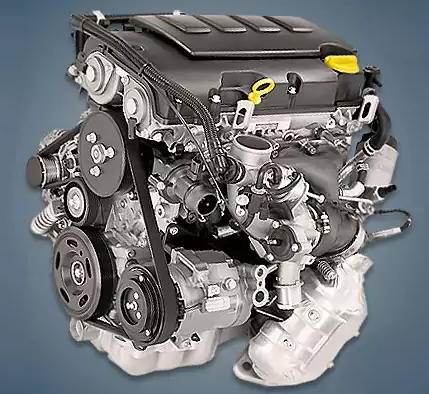
Since 2009, the Wien-Aspern plant has been assembling the 1.4-liter Opel A14NET or LUJ engine, which is fitted in several of the company’s well-known models, including the Astra, Meriva, Mokka, and Zafira. Modern Euro 6 engines from the new B-series are now gradually replacing such units.
A12XER, A14XER, A16XER, A16LET, A16XHT, and A18XER are all part of the A10 line.
The outcome of a novel approach to civilian engine construction is the Opel 1.4 engine. Low pressure turbocharging with a small displacement engine (the A14NET version uses just 0.5 bar). By lowering fuel consumption and boosting engine power, this guarantees high fuel efficiency. Hydraulic lifters and timing chain drives are installed. Both camshafts have a phase change system.
The engine was mounted on:
- Opel Astra J (P10) in 2009 – 2015;
- Opel Corsa D (S07) in 2010 – 2014;
- Opel Insignia A (G09) in 2011 – 2017;
- Opel Meriva B (S10) in 2010 – 2017;
- Opel Mokka A (J13) since 2012;
- Opel Zafira C (P12) since 2011.
Specifications
| Production years | since 2009 |
| Displacement, cc | 1364 |
| Fuel system | distributed injection |
| Power output, hp | 140 |
| Torque output, Nm | 200 |
| Cylinder block | cast iron R4 |
| Block head | aluminum 16v |
| Cylinder bore, mm | 72.5 |
| Piston stroke, mm | 82.6 |
| Compression ratio | 9.5 |
| Features | VIS |
| Hydraulic lifters | yes |
| Timing drive | chain |
| Phase regulator | DCVCP |
| Turbocharging | yes |
| Recommended engine oil | 5W-30 |
| Engine oil capacity, liter | 4.0 |
| Fuel type | petrol |
| Euro standards | EURO 5 |
| Fuel consumption, L/100 km (for Opel Astra 2013) — city — highway — combined |
7.8 4.7 5.9 |
| Engine lifespan, km | ~300 000 |
| Weight, kg | 120 |
Disadvantages of the A14NET engine
This series of motors is infamous for making noise, clicking, and whistling while in use, but this is typical;
Oil leaks from the crankshaft oil seal or beneath the valve cover rank second;
A complex crankcase ventilation system causes a lot of issues for the owner; the turbine can fail at 100,000 kilometers, and the pump has limited resources; in the early years of production, piston failure frequently occurred at low mileage.