
From 2004 to 2020, the Toyota 2GR-FSE 3.5-liter V6 engine was assembled at the company’s factories and mounted on rear or all-wheel drive models like the Crown, Mark X, Lexus IS, and GS. The combined fuel injection system D-4S is what sets this power unit apart.
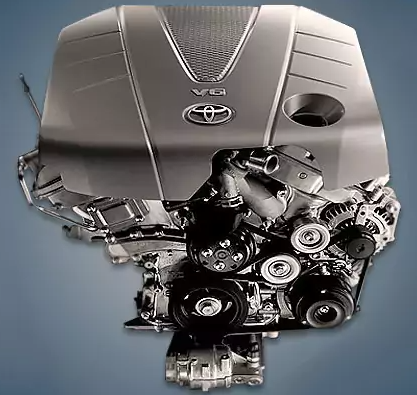
A 3.5-liter V6 engine with combined fuel injection D-4S, or direct and distributed simultaneously, made its debut on the well-liked Crown and Mark X models in Japan in 2004. Other than that, it is a standard V6 engine with an aluminum block and a 60° camber angle, two DOHC cylinder heads with hydraulic compensators, VVT-i phase shifters on every camshaft, a timing chain, and a plastic intake manifold with an ACIS-style geometry change system.
This engine was part of a hybrid power plant on the Lexus GS450h model, which also included a small battery, an electric motor, a gasoline unit, and a variator. Additionally, a TX15 supercharger version was available for the Crown S200 and Mark X models.
The engine was mounted on:
- Toyota Crown 12 (S180) in 2004 – 2008; Crown 13 (S200) in 2008 – 2012; Crown 14 (S210) in 2012 – 2018;
- Toyota Mark X 1 (X120) in 2004 – 2009; Mark X 2 (X130) in 2009 – 2019;
- Lexus IS300 3 (XE30) in 2013 – 2017;
- Lexus IS350 2 (XE20) in 2005 – 2013; IS350 3 (XE30) in 2013 – 2017;
- Lexus IS350C 2 (XE20) in 2008 – 2015;
- Lexus GS350 3 (S190) in 2005 – 2011; GS350 4 (L10) in 2011 – 2020;
- Lexus GS450h 3 (S190) in 2005 – 2011;
- Lexus RC350 1 (XC10) in 2014 – 2017.
Specifications
D* – derated version for Lexus IS 300;
U* – modification for models with index 350;
H* – hybrid modification for models with index 450h;
C* – charged modification for +M Supercharger models.
| Production years | 2004-2020 |
| Displacement, cc | 3456 |
| Fuel system | combined injection D-4S |
| Power output, hp | 255 (D*) 306 – 321 (U*) 296 (H*) 360 (C*) |
| Torque output, Nm | 320 (D*) 368 – 380 (U*) 368 (H*) 498 (C*) |
| Cylinder block | aluminum V6 |
| Block head | aluminum 24v |
| Cylinder bore, mm | 94 |
| Piston stroke, mm | 83 |
| Compression ratio | 11.8 (D*, U*, H*) 10.8 (C*) |
| Hydraulic lifters | yes |
| Timing drive | chain |
| Phase regulator | VVT-i |
| Recommended engine oil | 5W-20, 5W-30 |
| Engine oil capacity, liter | 6.3 |
| Fuel type | petrol |
| Euro standards | EURO 5 |
| Fuel consumption, L/100 km (for Toyota Crown 2005) — city — highway — combined |
13.8 8.1 10.0 |
| Engine lifespan, km | ~400 000 |
| Weight, kg | 179 |
Disadvantages of the 2GR-FSE engine
Many owners of these engines have experienced oil burner and fifth cylinder scuffing. There are two possible explanations for their appearance: a gap in the air filter that allows dust to enter the combustion chambers directly, or local overheating brought on by design flaws.
Motors manufactured between 2007 and 2008 were subject to a revocable campaign for the free replacement of faulty valve springs, which could easily burst because of metal impurities.
All GR series units have the issue of phase regulators crackling when the engine is started. Replacing the sprockets is frequently the only solution, but many need to purchase new couplings.
Ignition coils and a constantly leaking pump are two more weak points of this engine, and low-quality gasoline is a major concern for AFS mixture composition sensors and lambda probes. Leaks at the cylinder head joints and fuel pipe corrosion were common on early engines.