
Produced between 2004 and 2010, the 2.0-liter 8-valve Volkswagen BMM 2.0 TDI engine was fitted with a transverse power unit on a number of the company’s models. The fanciful piezoelectric unit injectors of this diesel engine are well-known.
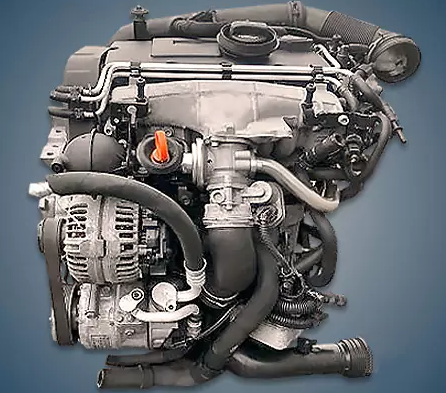
BKD, BKP, BMM, BMP, BMR, BPW, BRE, and BRT are also included in the EA188-2.0 series.
Specifications
| Production years | 2004-2010 |
| Displacement, cc | 1968 |
| Fuel system | unit-injectors |
| Power output, hp | 140 |
| Torque output, Nm | 320 |
| Cylinder block | cast iron R4 |
| Block head | aluminum 8v |
| Cylinder bore, mm | 81 |
| Piston stroke, mm | 95.5 |
| Compression ratio | 18.5 |
| Features | SOHC |
| Hydraulic lifters | yes |
| Timing drive | belt |
| Phase regulator | no |
| Turbocharging | VGT |
| Recommended engine oil | 5W-30 |
| Engine oil capacity, liter | 4.3 |
| Fuel type | diesel |
| Euro standards | EURO 4 |
| Fuel consumption, L/100 km (for Volkswagen Golf 2005) — city — highway — combined |
7.0 4.9 5.7 |
| Engine lifespan, km | ~280 000 |
| Weight, kg | 178 |
The engine was installed on:
- Audi A3 2 (8P) in 2005 – 2006;
- Skoda Octavia 2 (1Z) in 2005 – 2010;
- Seat Altea 1 (5P) in 2005 – 2010;
- Seat Leon 2 (1P) in 2005 – 2010;
- Volkswagen Caddy 3 (2K) in 2007 – 2010;
- Volkswagen Golf 5 (1K) in 2004 – 2008;
- Volkswagen Golf Plus 1 (5M) in 2005 – 2008;
- Volkswagen Jetta 5 (1K) in 2006 – 2008;
- Volkswagen Touran 1 (1T) in 2005 – 2010.
Disadvantages of the VW BMM engine
The unpredictability of its piezoelectric unit injectors is the cause of many diesel issues.
Thrust dips brought on by pollution and the turbine’s wedge shape come in second.
The loosening of the unit injectors’ fasteners is typically the cause of the rise in oil levels.
Additionally, the tandem pump’s seal might not be tight enough in this area.
The particulate filter is frequently totally clogged on runs longer than 200,000 kilometers.